CLIENT
The company faced challenges in training its contact center agents, who handle customer, restaurant, and delivery driver inquiries across voice, chat, and email. They needed an engaging and effective onboarding program to shorten the learning curve, reduce handling times, and improve customer satisfaction scores.
To support its vast user base, the company partners with contact center providers where agents handle inquiries via voice, chat, and email, ensuring smooth interactions for customers, delivery drivers, and restaurant partners.
“Paolo did an excellent job transforming our new hire training into an interactive learning experience.
The content was clear, engaging, and tailored to the real challenges our agents face. It made onboarding smoother and noticeably improved performance on the floor.”
Bianca Aruelo
Director, Learning Experience Delivery
CHALLENGE
The company faced challenges in training its contact center agents, who handle customer, restaurant, and delivery driver inquiries across voice, chat, and email. They needed an engaging and effective onboarding program to shorten the learning curve, reduce handling times, and improve customer satisfaction scores.
To address this, the company sought a more interactive, scenario-based learning approach—one that provided hands-on experience and equipped agents with practical skills to navigate the fast-paced food delivery environment effectively.
STRATEGY AND SOLUTION Test 02
Engagement in training, a new scenario-based, skills-driven onboarding program was developed. The focus was on real-world application, tool familiarity, and interactive learning to better prepare agents for live interactions.
- Scenario-Based Learning – Training was structured around top contact drivers, allowing agents to practice handling the most common customer, restaurant, and delivery driver inquiries through mock interactions and real-world scenarios.
- Skills-Focused Approach – Passive learning was reduced in favor of hands-on activities and simulations, ensuring agents developed the necessary problem-solving and communication skills for their role.
- Simulated Learning Environment – Tool simulations provided a realistic practice space, ensuring agents were comfortable using job tools before handling actual customer interactions.
By integrating interactive, skills-based learning, this approach helped new agents ramp up faster, improve response efficiency, and enhance the overall customer experience.
RESULTS (Test Two)
The new scenario-based curriculum was piloted by comparing two groups of new hires over a one-week product training period. Group A followed the traditional training model, while Group B participated in the interactive, eLearning-driven approach. Both groups’ performance was tracked across Average Handling Time (AHT) and Customer Satisfaction (CSAT) over 30 days, with operational targets of 12 minutes (720 seconds) AHT and 65% CSAT.
Here is their Week-on-Week Performance comparison:
AHT
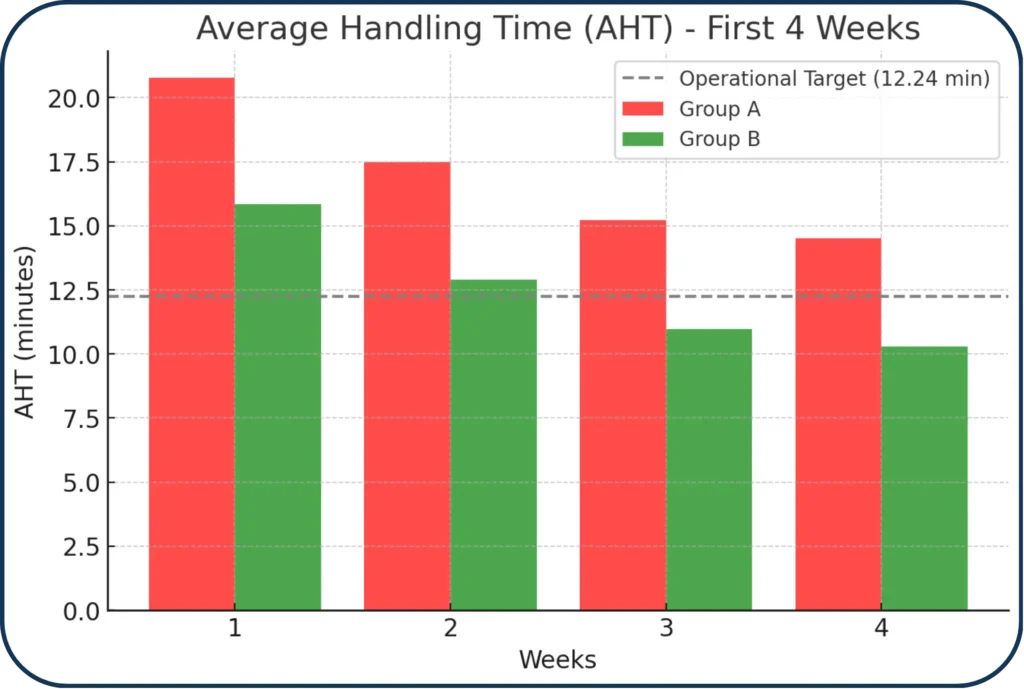
- Group A started with an AHT of 20.78 minutes in Week 1 and improved to 14.52 minutes by Week 4, but still remained above the 12.24-minute target.
- Group B started ahead at 15.84 minutes in Week 1 and met the operational target by Week 3 (10.97 minutes), continuing to improve by Week 4.
CSAT
- Group A’s CSAT performance fluctuated, starting at 27.08% in Week 1, improving slightly to 42.98% by Week 3, but dropping again to 30.05% in Week 4.
- Group B showed strong improvements, starting at 44.29% in Week 1 and surpassing the 65% CSAT target by Week 3 (66.67%).
Post-30 Days Performance Review
- After tracking the performance of Group A and Group B for their first 30 days (4 weeks) in operations, a follow-up assessment was conducted to measure the agent’s long-term performance from Weeks 5-12. The goal was to determine if the early improvements observed in Group B were sustained and whether Group A managed to catch up over time.
AHT Trends (Weeks 5-12)
- Group B continued to improve, maintaining an AHT consistently below 12 minutes after Week 3. By Week 12, their handling time had further improved to 8.61 minutes, showing sustained efficiency gains.
- Group A, however, struggled with fluctuations. While they improved to 13.46 minutes by Week 5, progress stalled, and they only reached the operational target (12.24 min) by Week 12.
CSAT Performance (Weeks 5-12) Test Two
- Group B continued to improve, maintaining an AHT consistently below 12 minutes after Week 3. By Week 12, their handling time had further improved to 8.61 minutes, showing sustained efficiency gains.
- Group A, however, struggled with fluctuations. While they improved to 13.46 minutes by Week 5, progress stalled, and they only reached the operational target (12.24 min) by Week 12.
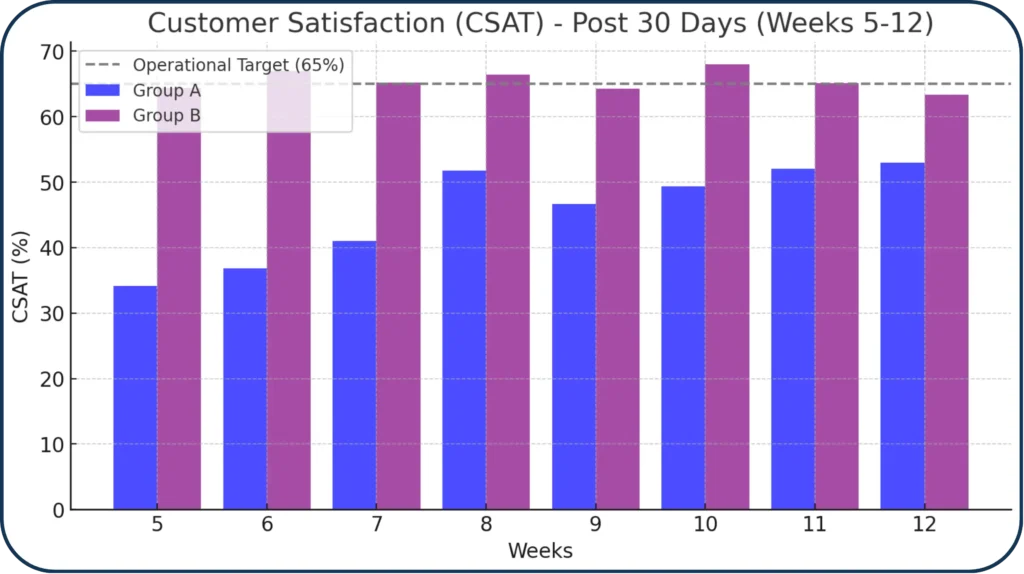
- Group B’s CSAT remained close to the 65% goal, peaking at 66.67% in Week 3 but fluctuating between 64.34% and 63.33% in later weeks. This suggests that while the new training approach had an immediate impact, additional reinforcement may be needed to sustain performance levels over time.
- Group A’s CSAT remained below target, showing irregular progress. While it reached 52.94% in Week 12, it still failed to meet the 65% benchmark, indicating that the traditional training method did not equip agents as effectively as the scenario-based approach.
KEY OUTCOMES (Test Two)
By shortening the learning curve for new hires, the new training approach accelerated agent readiness and improved operational performance much earlier in their tenure.
The training success reinforced the BPO’s ability to deliver high-quality support, leading the client to expand its partnership by adding more sites and ensuring a standardized onboarding experience across regions.